Pro Se Document Portal
Your submission has been received. A confirmation email will be sent. If you do not receive the email, please check your spam or junk folder.
This section of the website provides publications and resources that may be useful during the course of a bankruptcy filing. Some of the links may assist you in staying current regarding the law, procedures, and services available.
Note: Many of these resources are external websites. These links are provided for the user's convenience, therefore, the court does not control or guarantee the accuracy, relevance, timeliness, or completeness. The inclusion of these links is not intended to reflect their importance or endorsement of the resource nor any sponsorship.
Usually, the only formal proceeding at which a debtor must appear is the first meeting of creditors. The meeting is informally called a “341 meeting” because Title 11 Section 341 of the Bankruptcy Code requires that the debtor attend the meeting at which the trustee shall, and creditors may, question the debtor about their assets and debts. Creditors listed on a debtor’s schedules shall receive notice of the date and time of, and instructions for attending, the 341 meeting.
Foreclosure is an issue that is not part of the Bankruptcy Court's jurisdiction; however, the following informational resources are provided for your convenience.
Having problems accessing forms, click here for info on how to download.
A. Motions and Related Notices
Abandonment, Notice only
Adequate Protection Distributed by Trustee, Joint Motion for
Official Procedure Last Change August 9, 2021
How to file:Location of event: Bankruptcy > Motions, Applications & Briefs > Extend Time to File Proof of Claim, Motion to |
If a document is restricted it has been hidden from public view. A document can be restricted for various reasons. The most common reason is the presence of personal identifiers. Review the Motion for Protective Order, Motion to Redact, and/or Motion to Restrict Public Access procedures available on the Court’s procedures manual for more information.
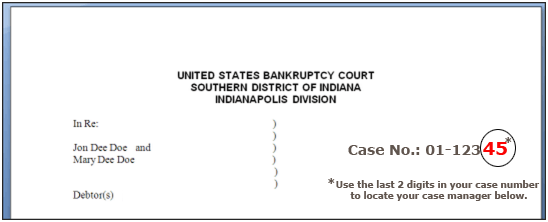
To find the case administrator assigned to a particular case, look at the case number found on the document(s) you have received. The last two digits in the second set of numbers indicate which case administrator is assigned – in the example below the digits are 45.
Contact your attorney. If you are not represented by an attorney, contact the chapter 13 trustee assigned to your case.
Click here to return to Debtor Questions.
If you need to amend information from the voluntary petition, statements and/ or schedules review the relevant procedures on the Court’s Procedures Manual. You can also use this link if you are trying to find instructions on how file other items as well.
The Court’s forms page will facilitate access to local and national forms for use when amending the voluntary petition, statements and schedules.
Click here to return to Debtor Questions.